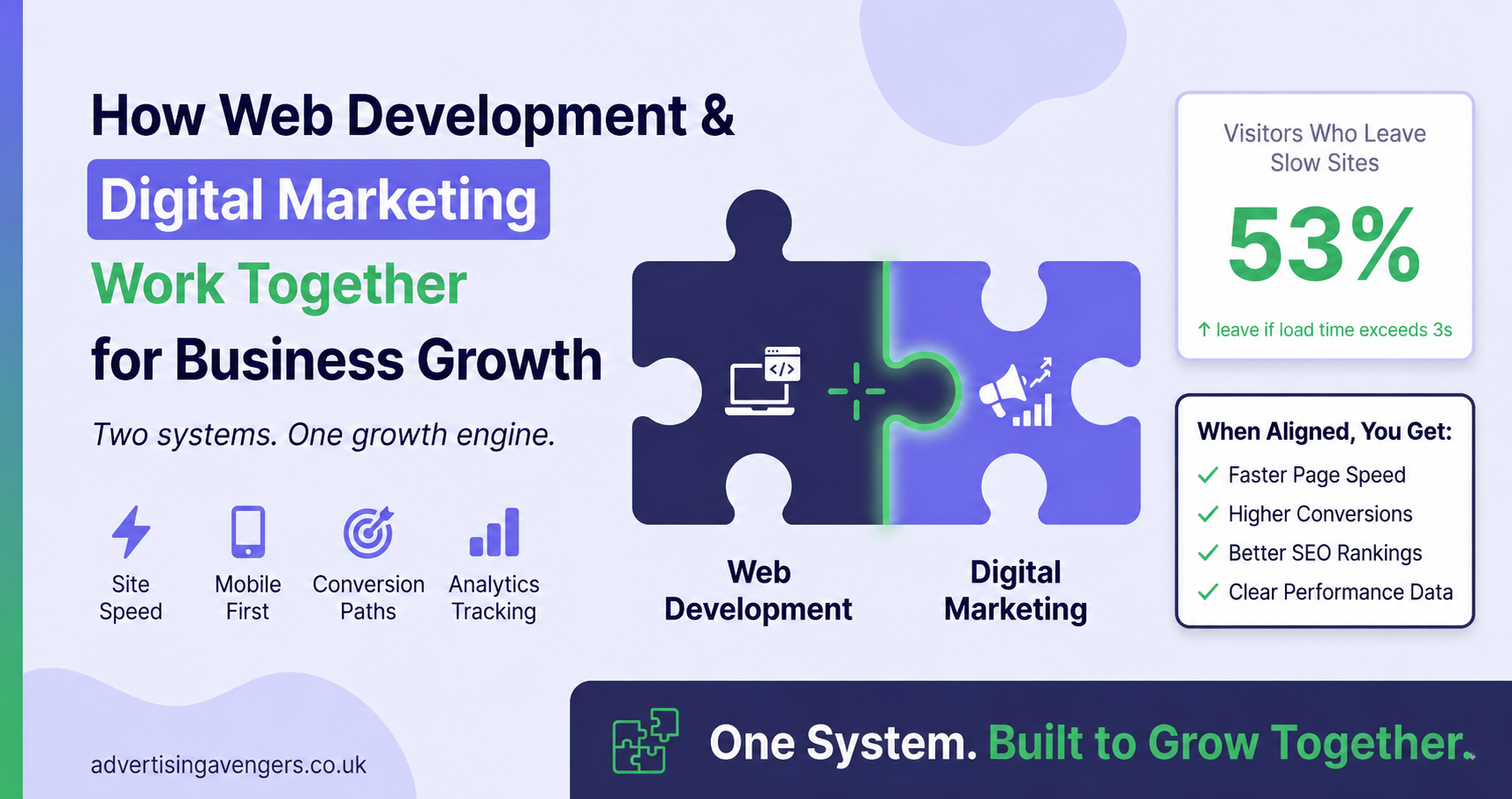
Most businesses treat their website and their marketing as two separate things. The design team builds the site. The marketing team runs the campaigns. And somewhere in between, results fall short.
Here’s the truth: Web development and digital marketing are not separate strategies. They are two parts of the same system. When they work together, businesses grow faster, attract better leads, and convert more visitors into customers.
This post explains how the two connect, why that connection matters, and what it means for your business.
Why Your Website Is a Marketing Asset
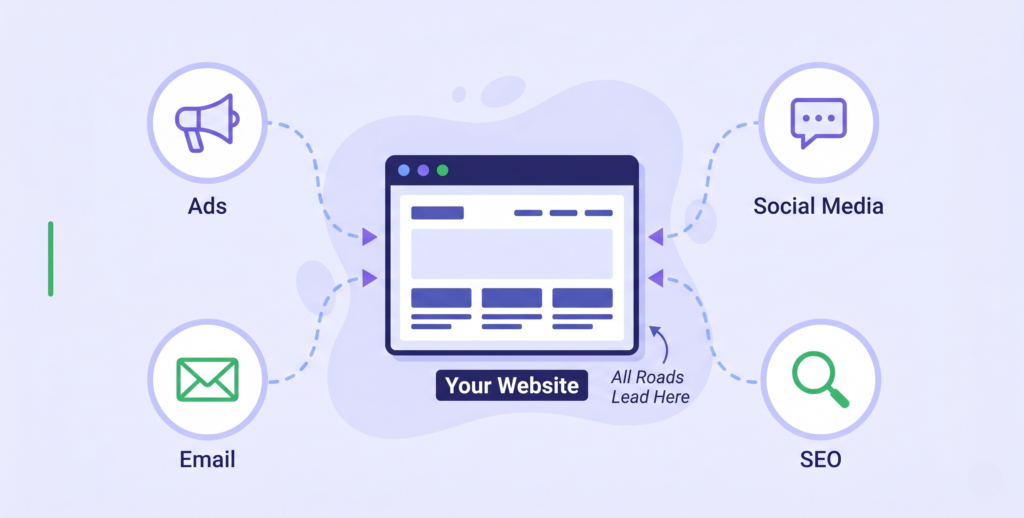
The website isn’t a mere virtual business card; it forms the basis of all the marketing efforts you conduct.
Consider that all your advertisements, posts on social media pages, and emails always lead your clients to one website address. If the website isn’t working well, your entire budget goes down the drain since there are no conversions.
According to Google, 53% of people browsing on their phones leave a site that takes more than 3 seconds to load. This is not a problem with marketing but with web development, and it has severe marketing implications.
Here, web development services become an important element of your growth strategy rather than just a technology cost.
How Web Development Supports Digital Marketing
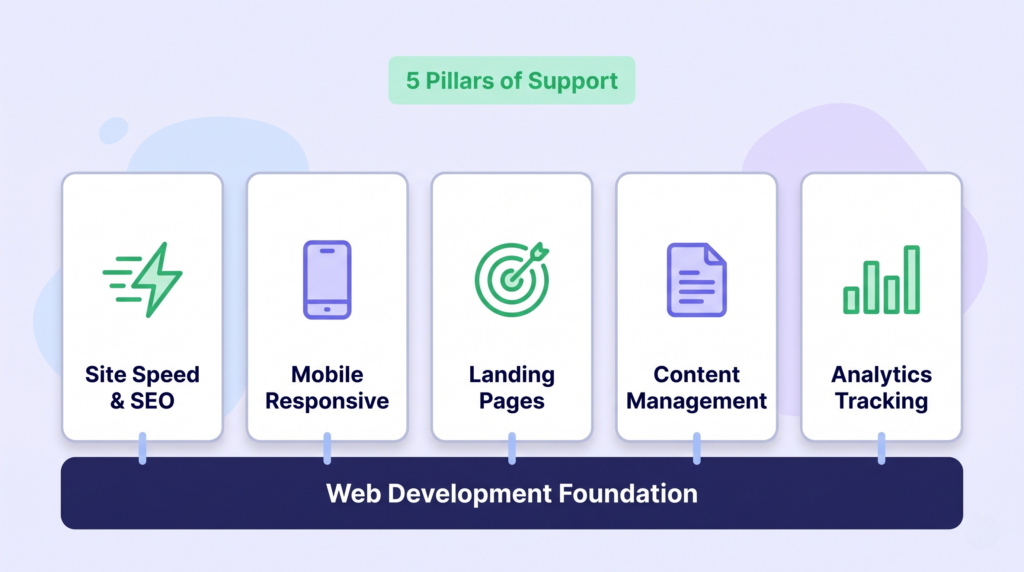
Good web development creates an environment where marketing can actually work. Here are the key areas where the two overlap directly.
1. Site Speed and SEO
The ranking of websites depends on their loading speed in the search results. If a website has been built properly, it will load faster and have clear code. There is a high chance it will rank highly in search engines.
Slow sites rank lower. Lower rankings mean less organic traffic. Less traffic means fewer leads.
A strong development foundation supports your entire SEO strategy from the ground up.
2. Mobile Responsiveness
Over 60% of worldwide internet traffic is now generated by mobile devices. This means that a website without proper mobile optimization loses a considerable part of its audience right from the start.
The process of marketing-oriented web development guarantees that your website performs seamlessly across all devices. This improves user experience, lowers bounce rate, and boosts conversion rates.
3. Landing Pages and Conversion Paths
In any paid digital marketing campaign, whether through email or social media promotion, a landing page is highly critical to success. A landing page is one that encourages visitors to take a specific action in response to your campaign efforts.
Creating a landing page requires both marketing knowledge and technical skills. Everything about the design, speed, forms, and call to action needs to be integrated.
4. Content Management and Publishing
Content publication is probably one of the best methods in digital marketing to adopt. Articles, case studies, and guides can help drive more organic traffic to your business while establishing credibility for your brand in your market space.
But if your website makes it hard to publish, update, or manage content, your marketing team will struggle to keep up. This is why CMS development matters. A well-configured content management system enables your team to publish and update content quickly, without needing a developer each time.
Popular platforms like WordPress, Webflow, and HubSpot CMS allow marketing and development teams to move faster together.
5. Analytics and Tracking Setup
You can only enhance something that you can measure. In digital marketing, there is heavy use of data analysis, including which pages are most visited, where users abandon their navigation, and how many users engage with particular marketing campaigns.
Setting up the right kind of tracking involves development. This includes installing Google Analytics, setting up conversion events, using heatmap tools, and integrating advertisements on your website. Lack of proper tracking leaves you with only assumptions when making marketing decisions.
The Role of Custom Web Development in Marketing Success
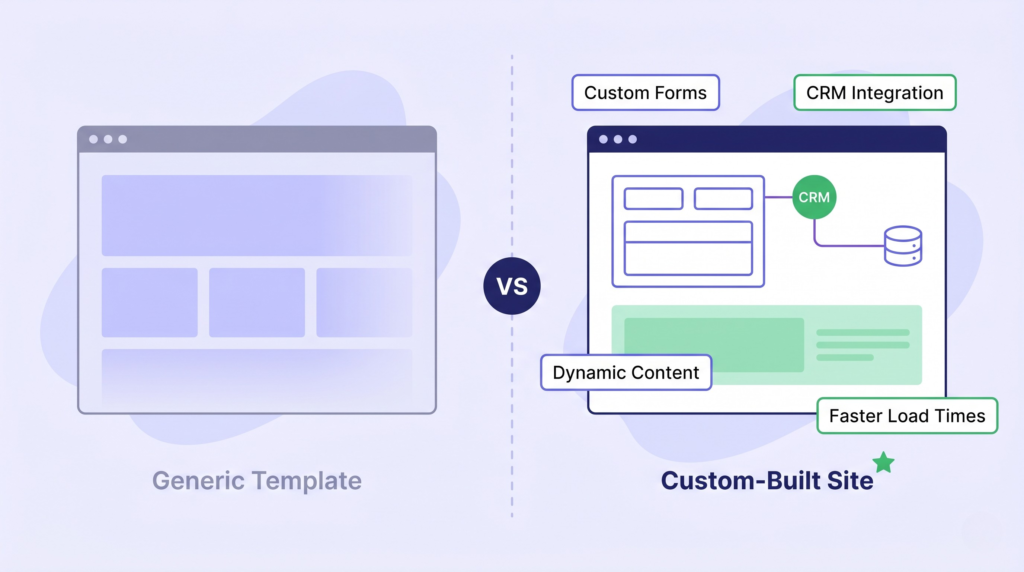
Website builders provide pre-defined web templates that you can use to kick-start your site-building efforts, but they have their disadvantages too – they might not necessarily meet your specific needs.
Custom web development gives businesses the flexibility to build exactly what their marketing strategy requires. This might include:
- Custom lead capture forms connected to a CRM
- Personalized content based on user behavior
- Integration with email marketing platforms
- Landing pages with dynamic content according to the advertisement campaign
- Faster load times through optimized, lean code
The more marketing-oriented your site is, the greater the effect you will see.
Digital Business Transformation Starts with the Right Foundation
While many organizations implementing digital business transformation pay close attention to their marketing channels – such as advertisements, social media, and e-mailing, that’s right. Still, none of that matters if they don’t have an effective website to support them.
The website is where digital transformation comes to life for your customers. It’s where they learn about you, decide if they trust you, and take action. Every marketing channel feeds into it.
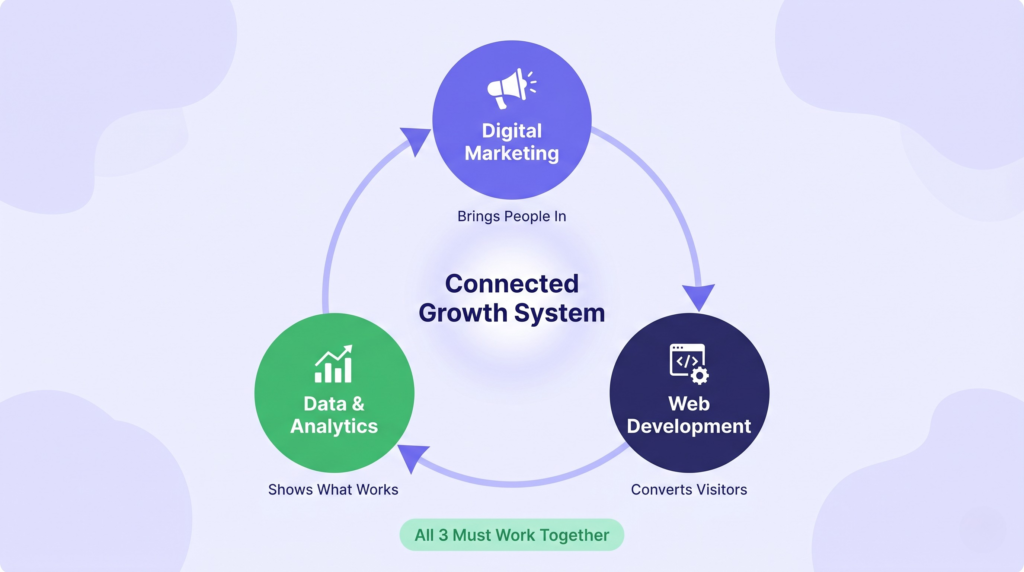
Here is a simple way to think about the relationship:
- Digital marketing brings people to your site.
- Web development ensures the site converts those visitors into customers.
- Data and analytics tell you what’s working so you can improve both.
All three have to work together. Ignore one, and the whole system weakens.
Signs Your Web Development and Marketing Are Not Aligned
It is worth checking whether your current setup has gaps. Here are some common signs that development and marketing are not working in sync:
- Your site loads slowly, especially on mobile.
- You cannot update your blog or landing pages without a developer.
- Your marketing campaigns drive traffic to a generic homepage rather than a targeted page.
- You have no idea which pages or campaigns are actually driving leads.
- Your forms are long, confusing, or not connected to your CRM
- Your site looks different on mobile than it does on desktop.
If any of these sound familiar, the issue is likely not your marketing strategy. It’s the foundation beneath it.
What to Look for in a Web Development Partner
If you are looking to close the gap between your website and your marketing, the right development partner makes a significant difference.
Look for a team that understands both sides. Not just a team that can write clean code, but one that understands user journeys, conversion logic, and marketing integration. A team that offers full web development services with a marketing-aware approach will help you build something that actually grows your business.
Key things to look for include:
- Ability to create using SEO development
- Knowledge of marketing tools like HubSpot, MailChimp, or Salesforce
- Track record of developing pages for conversion optimization
- Correctly configuring and educating CMS usage internally.
- Testing and optimizing websites
Final Thoughts
Web development and digital marketing are most powerful when treated as a single, connected system. Your website is not just a place to park information. It is an active part of your marketing strategy.
When your site is fast, easy to use, and built with conversion in mind, every marketing campaign you run performs better. Every rupee or dollar spent on ads, content, or social media goes further.
It is clear that those organizations integrating business developments with marketing efforts are going to make it big.
If your website and marketing aren’t working together yet, now is a good time to start.