
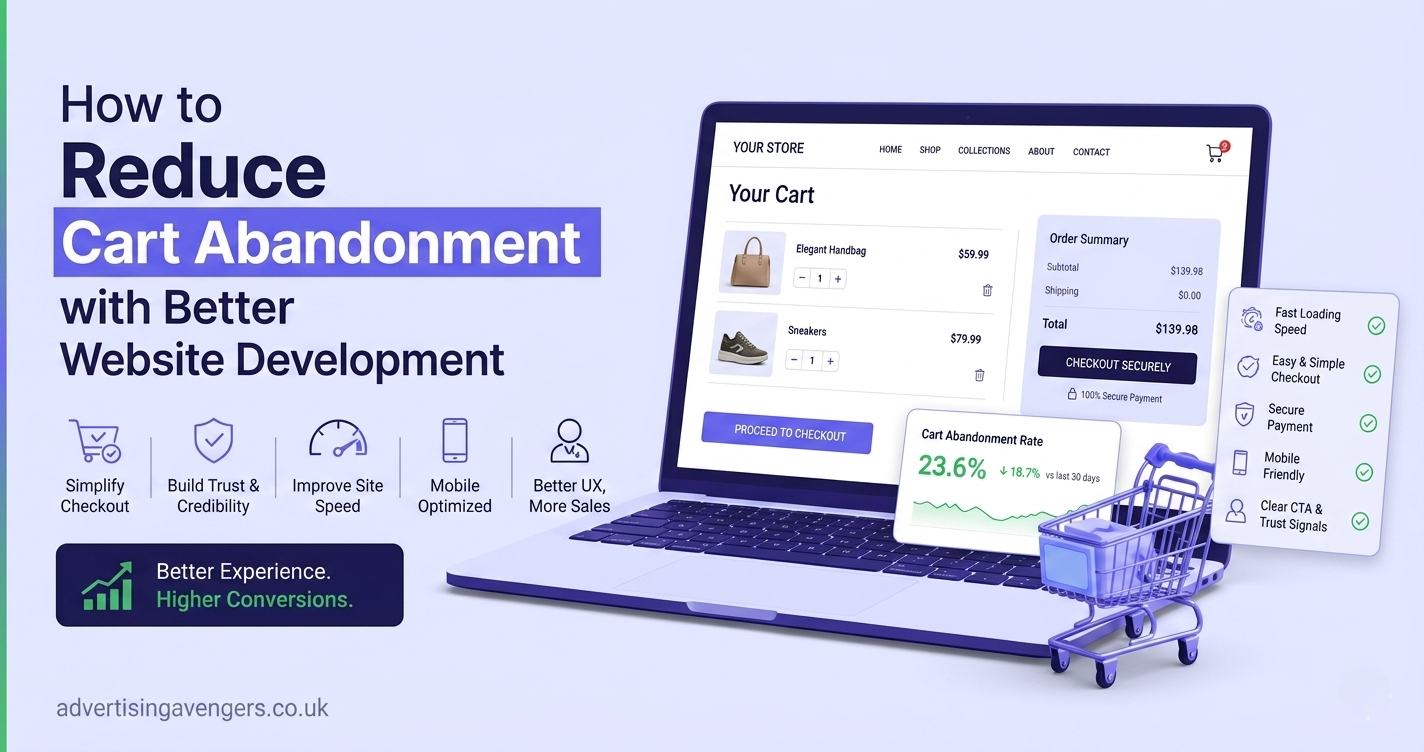
Cart abandonment isn’t just a missed sale – it’s a breakdown in experience at the exact moment intent peaks. A customer has already done the hard part – they’ve discovered your product, evaluated it, and decided to buy it. Yet something in the final stretch makes them pause, reconsider, and leave. If you want to reduce cart abandonment, the focus has to shift from persuasion to precision. Because today, conversions aren’t won through marketing alone – they’re secured through how intelligently your website is built to guide, reassure, and complete the journey without friction.
In this blog, we explore how smarter development decisions can reduce cart abandonment and improve checkout conversions.
Why Cart Abandonment Happens?
Shoppers today are decisive. When they add a product to the cart, they already have intent. What interrupts that intent is friction. Here’s what typically goes wrong:
- The checkout feels longer than expected
- Costs appear too late in the process
- The site slows down at critical moments
- Payment options feel limited or unfamiliar
- The interface creates doubt instead of confidence
- The mobile experience breaks flow
- Trust signals are missing where they matter most
Even high-performing brands struggle here. Industry benchmarks still show cart abandonment hovering around 70%, which means most e-commerce journeys break.
This is not a traffic problem. It is a development problem.
The Role of Website Development in Conversion
Modern commerce is moving away from static checkout pages toward dynamic, frictionless conversion systems. The best-performing brands treat checkouts like a guided journey – not a form to fill. Every step is intentional. Every interaction reduces effort.
This is where website development services play a decisive role. Not just in building pages – but in shaping behavior.
A high-performing checkout system does three things exceptionally well:
- Removes uncertainty (clear pricing, delivery, returns)
- Reduces effort (fewer fields, autofill, saved preferences)
- Builds confidence (secure, familiar, predictable flow)
When these elements align, users don’t “complete checkout.” They simply continue.
High-Impact Development Fixes That Actually Work
If your goal is to reduce cart abandonment, focus on the areas where friction compounds. Small improvements here create disproportionate gains.
1. Simplify the Checkout Flow
Every extra step increases the chance of drop-off.
- Reduce the number of checkout pages
- Combine steps where possible
- Use progress indicators to guide users
- Eliminate unnecessary fields
2. Make Guest Checkout Effortless
Forcing account creation is still one of the biggest conversion killers.
- Offer guest checkout as the default option
- Allow users to create an account after purchase
- Avoid interrupting the buying flow with sign-up prompts
- Use social or OTP-based quick sign-ins
The goal is to remove commitment until and after the transaction is complete.
3. Make Pricing Transparent from the Start
Unexpected charges at checkout are a major drop-off trigger. If the final price feels different from what they expected, the sale is already at risk.
- Show shipping costs early
- Be transparent about taxes and fees
- Provide delivery timelines upfront
- Highlight the total cost clearly before payment
When users feel informed, they are more likely to proceed without hesitation.
4. Build Trust into the Checkout Experience
Trust is not built on the homepage – it is built at the payment stage.
- Add security badges near payment fields
- Display return and refund clarity
- Delivery guarantees
- Include visible customer support access
Even subtle signals can influence whether a user clicks “Pay” or leaves.
5. Optimize Speed Where It Matters Most
Performance directly impacts buying behavior. Even a slight delay can break purchase intent. Research indicates that even a 1-second delay in page load time can reduce conversions by up to 7%.
Development priorities:
- Optimize Core Web Vitals
- Use lazy loading for non-essential elements
- Compress assets without compromising quality
- Leverage CDN and caching
Speed isn’t just technical – it’s psychological. Faster experiences feel easier and more trustworthy.
6. Prioritize Mobile-First Checkout
Most users today are browsing – and buying – on mobile. With responsive web development, your checkout should:
- Use large, tappable buttons
- Minimize typing with autofill
- Keep layouts clean and uncluttered
If the mobile experience feels clunky, the cart is already at risk.
What Businesses Get Wrong About Fixing Cart Abandonment?
Most brands jump to tactics like:
- Sending reminder emails
- Offering discounts
- Running retargeting ads
While these help, they treat the symptoms – not the cause. If your checkout experience is broken:
- Discounts won’t fix trust
- Emails won’t fix friction
- Ads won’t fix usability
The real solution lies in development.
A Phased Roadmap to Reduce Cart Abandonment Through Smarter Development
You don’t need a full rebuild to see results. Start with focused improvements that directly impact checkout performance.
Immediate fixes:
- Enable guest checkout
- Reduce form fields to essentials
- Add multiple payment options
- Show a full cost breakdown early
- Optimize checkout speed
Mid-term improvements:
- Introduce express checkout options
- Implement mobile-first redesign
- Use smart autofill and saved preferences
- Integrate trust signals at key touchpoints
Long-term strategy:
- Build AI-driven personalization into checkout
- Create adaptive flows based on user behavior
- Continuously test and refine UX patterns
These are not just upgrades – they are practical cart abandonment solutions that compound over time.
The Shift Toward Faster, Frictionless Checkout
When brands invest in e-commerce website development for conversions, they are not just improving visuals – they are engineering a smoother decision-making path.
E-commerce is moving toward speed and simplicity at an accelerated pace. Recent innovations are redefining how checkout works:
- One-click payments and digital wallets
- Autofill-enabled guest checkout experiences
- Checkout flows that avoid page redirection entirely
Some platforms are even reducing checkout to a near-instant interaction, where user data and payment preferences are preloaded, cutting completion time significantly.
For brands looking to improve their checkout conversion rate, this is the direction to watch – less effort, fewer steps, faster completion.
What Does this Mean for Growing Businesses?
If you’re planning to hire web developers for small business growth or scale your digital store, focus on high-impact changes first.
Start with:
- Checkout flow simplification
- Mobile optimization
- Payment acceleration
- Transparent pricing
Then move toward advanced improvements like personalization and predictive UX. This phased approach ensures measurable results without overhauling your entire platform.
Conclusion
To truly reduce cart abandonment, brands need to move beyond surface-level fixes and focus on the mechanics of the experience. Speed, clarity, trust, and simplicity are not enhancements – they are expectations. And the brands that engineer these elements into their checkout flow are the ones that consistently win conversions.
Looking to turn your website into a conversion engine? Speak to our experts today.