
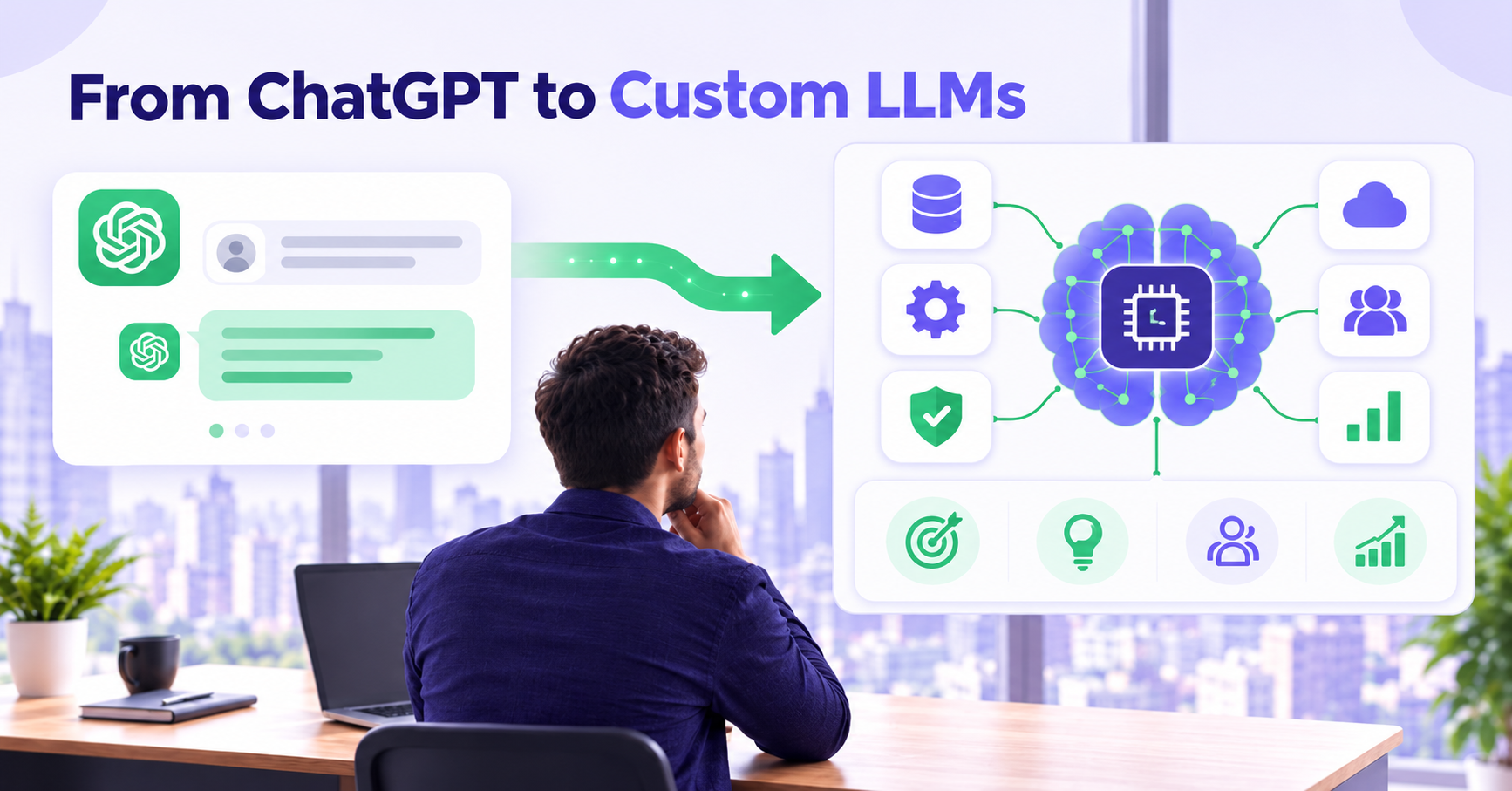
For many businesses, AI adoption started with a simple experiment: open ChatGPT, ask a question, generate some content, or summarize a document.
That was a useful starting point. But businesses quickly run into a bigger question: What happens when AI needs to work with the software, data, and processes the business already uses?
That is where AI Integration comes into the picture.
Instead of treating AI as a separate tool, companies can connect it with CRM platforms, ERP systems, databases, internal applications, customer portals, cloud platforms, and everyday workflows. The result is not just another chatbot. It is AI working within the business environment.
What Does AI Integration Actually Mean?
In other words, AI integration is when the AI is made part of the existing business process or application.
For example, take a sales team that currently utilizes a CRM. The workers can end up spending their time going through the prior conversation, looking into the customer’s record, and writing out follow-up emails.
The same principle applies to other business systems.
AI can be connected to:
- CRM and ERP platforms
- Business databases
- Web and mobile applications
- Cloud services
- Internal knowledge bases
- Data warehouses
- Third-party APIs
- Enterprise workflows
This creates a clear difference between using AI and integrating AI.
Using ChatGPT independently might help an employee complete a task. Integrating AI into an application makes that capability available as part of the application itself. A more customized solution can go a step further by connecting AI with company-specific data, processes, permissions, and business rules.
For companies planning this type of implementation, AI Integration Services can help connect AI capabilities with the systems they already have in place.
From ChatGPT to Custom LLMs: How Business AI Has Changed
The path many businesses are following looks something like this:
ChatGPT → AI APIs → RAG → Customization → Integrated AI Applications
The first stage is experimentation. Employees use general-purpose AI tools to understand what the technology can do.
The next stage is integration. Businesses start using AI APIs to add capabilities such as summarization, content generation, classification, or conversational interfaces to their own applications.
Then comes the need for business-specific information.
A general-purpose model may know a lot about the world, but it does not automatically know a company’s latest product documentation, internal policies, customer records, or proprietary processes. That’s where approaches such as Retrieval-Augmented Generation (RAG) become useful. Instead of expecting the model to know everything, the application can retrieve relevant information from approved sources and provide that context to the model.
Some organizations may eventually require fine-tuning or more customized LLM solutions. However, a custom model is not automatically the right choice for every business.
The decision usually comes down to practical requirements such as:
- How much business-specific knowledge is involved?
- What systems need to be connected?
- How sensitive is the data?
- How much control is required?
- What level of customization is necessary?
- How will the solution be maintained?
ChatGPT Integration vs. Custom LLM Integration
There is no single AI architecture that works for every company. A simple use case may only require an existing AI service, while a complex enterprise application may require several integration layers.
| Factor | Prebuilt AI | Custom LLM-Based Solution |
| Setup | Relatively straightforward | Requires development and integration |
| Customization | More limited | Can be tailored to business requirements |
| Business knowledge | Depends on available context | Can use approved company-specific information |
| Application integration | Possible through available tools/APIs | Designed around specific systems |
| Control | Depends on the platform | Greater control over the application |
| Security | Requires appropriate configuration | Can be designed around business requirements |
| Cost | Usually easier to start | Depends on architecture and development scope |
| Typical use | Productivity and experimentation | Specialized business applications |
The important point is that businesses do not necessarily need to choose between “ChatGPT” and “custom LLM.” There are several approaches in between.
What Business Systems Can AI Connect With?
One of the biggest opportunities for enterprise AI integration is connecting AI with systems that already contain useful business information.
CRM Systems
AI can work alongside CRM platforms to support customer-facing teams.
Possible applications include:
- Summarizing customer interactions
- Preparing sales follow-ups
- Assisting with lead qualification
- Finding relevant customer information
- Supporting customer service teams
Instead of asking employees to move between several tools, AI capabilities can be incorporated into the workflow they already follow.
ERP Systems
ERP platforms contain information about operations, finance, inventory, purchasing, and other business activities.
AI can help users interact with this information more naturally, support reporting, analyze operational data, or assist with recurring workflows.
Business Applications
AI does not have to live in a separate application.
Software companies can integrate AI directly into web and mobile products to provide features such as intelligent search, recommendations, summarization, conversational interfaces, and content generation.
This is particularly useful when AI is part of the product experience rather than an external add-on.
Databases and Data Warehouses
Businesses often have large amounts of information spread across structured and unstructured sources.
With appropriate permissions and controls, an AI application can retrieve relevant information from those sources and use it to answer questions or support business workflows.
APIs and Third-Party Services
AI API integration provides another practical route. Instead of developing a model from scratch, developers can connect an existing model to an application and use it for specific functions.
This can significantly change how AI features are introduced into existing software.
Where Do Custom LLMs Fit?
The term “custom LLM” can sometimes be misleading.
It does not always mean training a completely new language model from the ground up. In many projects, customization happens at the application and data layers.
Businesses can choose from approaches such as:
- Using a hosted LLM
- Connecting an existing model through an API
- Implementing RAG
- Connecting proprietary business data
- Fine-tuning a model
- Building an application around an LLM
- Training a model from scratch when there is a strong technical reason to do so
For example, a company may not need its own foundation model. It may instead need an internal knowledge assistant that can securely search company documents and provide useful answers.
That is still a customized AI application.
Organizations with more specialized requirements can explore LLM Development Services as part of a broader AI implementation strategy.
Practical AI Integration Use Cases
The value of AI becomes easier to understand when it is connected to a specific business problem.
1. Customer Support
An AI system can connect with approved knowledge sources and support platforms to help answer common customer questions or assist support agents.
2. CRM Assistance
Sales representatives can use AI to summarize customer histories, prepare meeting notes, or find relevant information without manually reviewing multiple records.
3. Internal Knowledge Search
Employees may have to waste a lot of time in searching for information from various portals, documents, and databases. With an AI knowledge assistant, employees can use a natural language interface to access approved information sources.
4. Document Processing
AI can help extract information from contracts, forms, invoices, reports, and other business documents before passing that information into another workflow.
5. Reporting
Instead of simply displaying dashboards, applications can use AI to turn business data into readable summaries and help users explore specific questions.
6. AI-Powered Product Features
Software companies can add AI directly to their products through features such as conversational search, recommendations, summarization, and intelligent assistance.
The common thread is simple: AI works best when it is connected to a clearly defined workflow.
What Happens Behind the Scenes?
A basic AI integration architecture may look like this:
User → Application → AI Layer → LLM/API → Business Data → Enterprise Systems
While the architecture itself may be more complicated, there are usually a number of components between the user and the AI.
These may include:
- APIs
- Authentication
- Data pipelines
- RAG
- Vector databases
- Application logic
- Model services
- Monitoring
- Security controls
For business leaders, the important point is that the model is only one part of the system.
The surrounding architecture determines what information the AI can access, how that information is retrieved, how users interact with it, and what controls are applied.
Challenges Businesses Should Consider
AI implementation also brings practical challenges.
Data security should be considered before sensitive information is connected to an AI workflow. Businesses need clear rules around access, storage, and processing.
Accuracy is another consideration. AI-generated responses can contain errors, so important workflows may require validation, human review, or access to reliable source information.
Another aspect to take into consideration is the integration of AI with legacy systems. Since old applications lack good APIs and proper data structure, implementation becomes difficult.
Other factors include:
- Data quality
- Permissions
- Choice of model
- Complexity of integration
- Costs related to infrastructure
- Scalability
- Regulatory compliance
- Monitoring
- Human supervision
Starting with a limited use case can help a business identify these issues before expanding the solution.
How Should a Business Choose an AI Integration Approach?
The starting point should be the business requirement, not the latest AI trend.
Prebuilt AI tools can be useful when teams are experimenting or need general-purpose assistance.
AI APIs make sense when a company wants to introduce AI capabilities into an existing application.
RAG-based solutions are useful when an application needs to work with company-specific documents or knowledge.
Fine-tuned models may be considered when a particular task requires more specialized model behavior.
Larger custom AI systems can make sense when multiple applications, data sources, workflows, and security requirements need to work together.
In other words, the right approach depends on the problem being solved.
A Practical AI Integration Roadmap
Businesses can approach implementation in stages:
- Identify the business problem.
- Define the specific AI use case.
- Review available data and its quality.
- Select the appropriate model or AI service.
- Design the integration architecture.
- Build a proof of concept.
- Connect the required business systems.
- Add security and governance controls.
- Test the AI outputs.
- Deploy and monitor the solution.
- Improve it based on actual usage.
This approach gives teams an opportunity to learn what works before committing to a broader rollout.
Where Is AI Integration Heading?
AI is gradually moving from standalone tools into the software businesses already use.
AI agents, multi-model systems, enterprise knowledge platforms, automated workflows, and AI-powered product features are all becoming part of the broader conversation around enterprise software.
The technology will continue to change, but the business principle remains straightforward: AI should solve a real problem, work with relevant information, and fit into the way people already work.
Final Takeaway
AI integration is not simply about adding ChatGPT to a website. It is about connecting AI capabilities with applications, data, workflows, APIs, and business systems.
For some companies, an existing AI service may be enough. Others may need RAG, API-based integration, fine-tuning, or a more customized LLM application.
It will depend on the firm’s objectives, the available technology, data, security needs, and budget. Beginning with the business issue and choosing the technology next would offer a more realistic approach to applying AI.