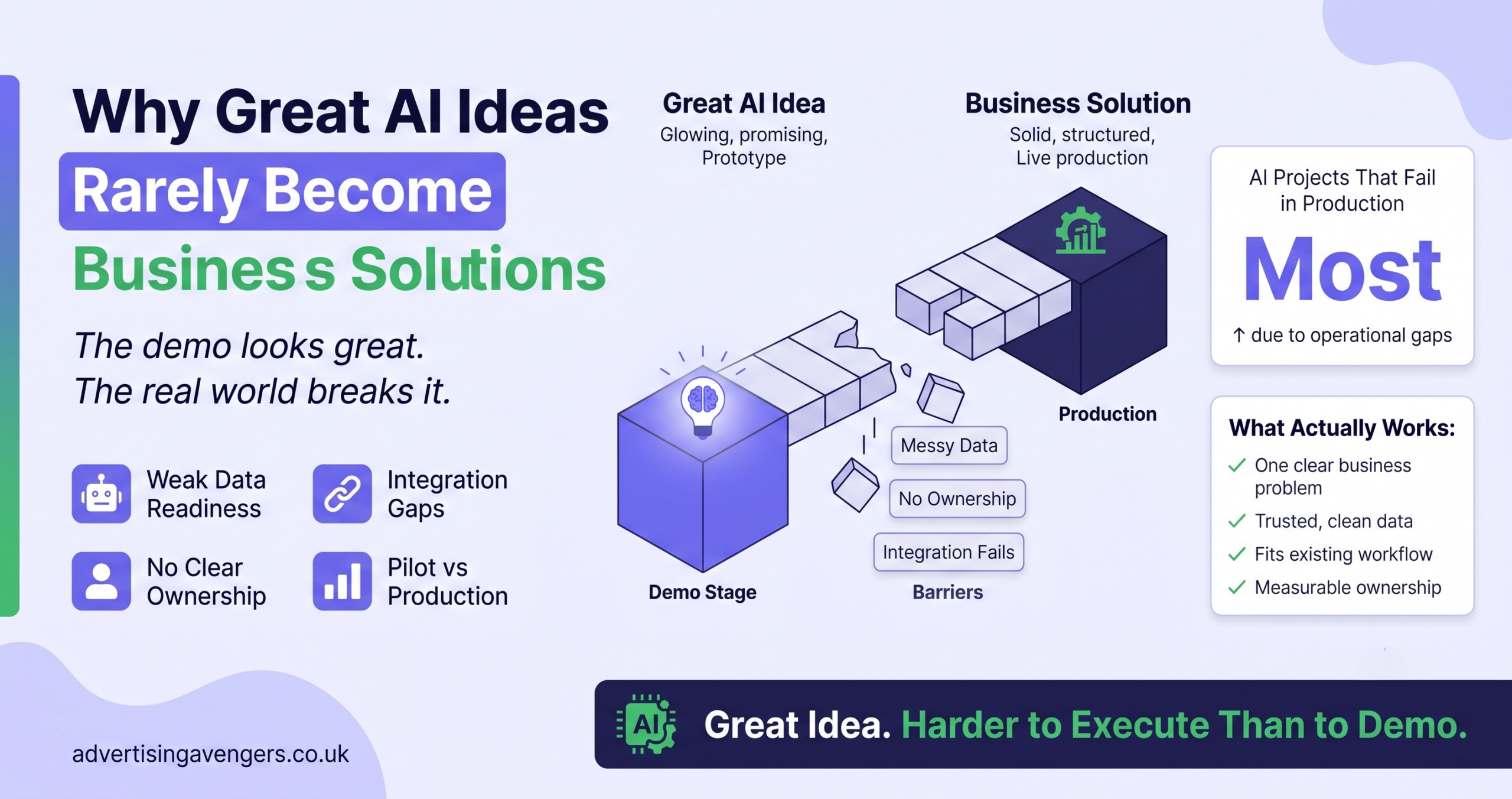
Many teams have no shortage of AI ideas. They have prototypes, workshop notes, and a long list of things that could be automated. The problem is that great ideas do not automatically become useful products. Currently, the gap between “interesting AI” and real business value is still wide, even as the market shifts toward agentic systems that can plan, coordinate, and execute multi-step work. That is exactly why artificial intelligence solutions fail so often – the idea is usually stronger than the operating model behind it.
The latest trend is not simple chatbots anymore. The next wave of AI is less about generating responses and more about getting meaningful work done. Businesses are beginning to adopt intelligent systems that can navigate workflows, use multiple tools, and complete tasks with minimal supervision. The ambition is real. The execution, however, is where most teams stumble.
The Idea Is Not the Hard Part
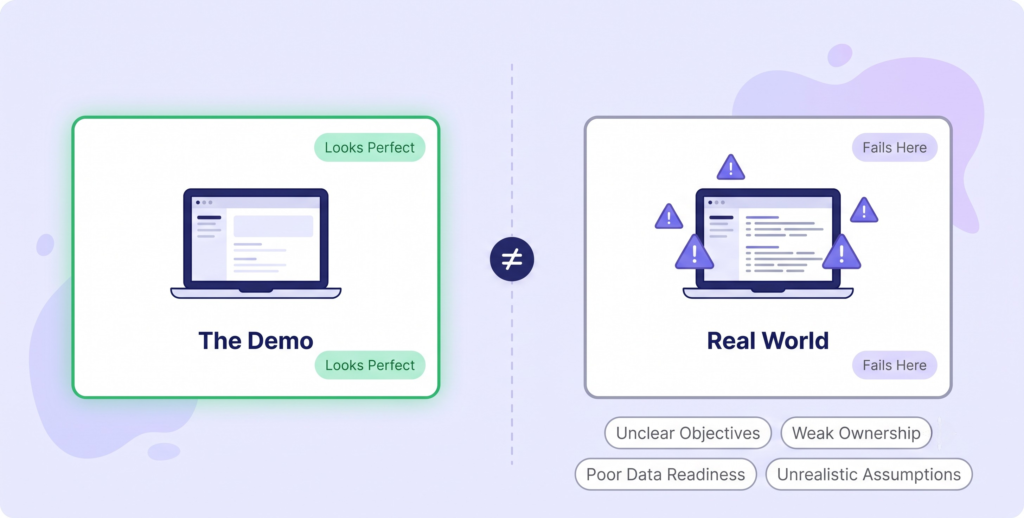
Most AI projects fail not because the model cannot produce an answer. They fail because the business problem never got turned into a working system. The latest industry guidance on AI project failure continues to point to the same patterns – unclear objectives, weak ownership, poor readiness, and unrealistic assumptions about how a pilot will behave once it meets the real world.
That’s where a lot of companies conflate experimentation with execution. The demo may look polished, even if the underlying workflow is fragile. A business solution has to survive messy data, changing users, security checks and operational pressure. That is a very different trial. When a team moves too quickly from concept to production, the promise of AI solutions begins to fall apart under ordinary business complexity.
Data Is Available – Usable Data Is Not
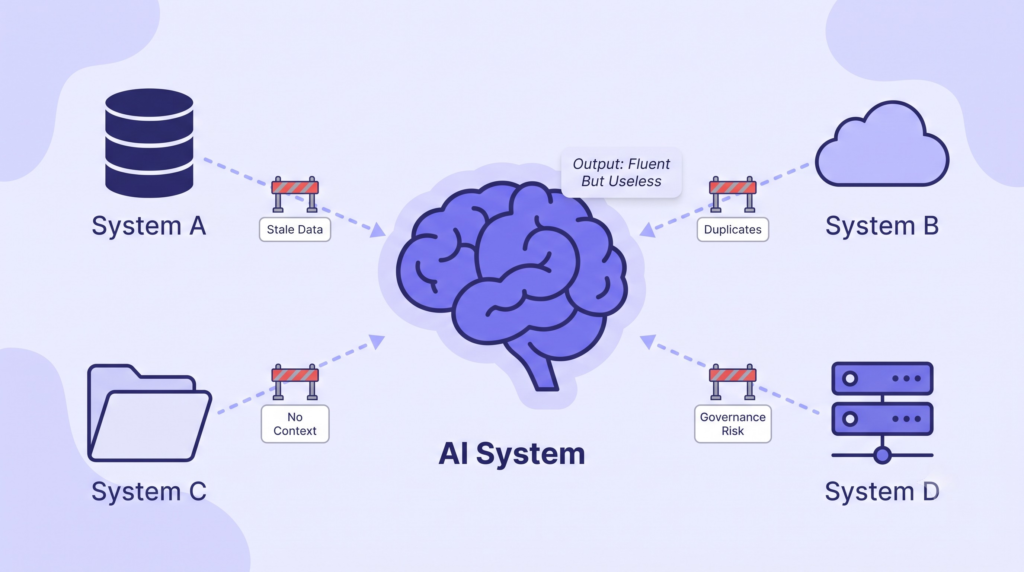
One of the most frequently cited reasons for AI project failure is that companies don’t have enough data. In practice, the problem is usually that the data are not ready for use. It’s in different systems, has no context, has duplicates, or is too inconsistent to give reliable results. Data quality, readiness and integration remain the most common barriers to successful AI implementation.
That is even clearer in the development of generative AI. Teams often think it’s a better prompt the model needs, when in fact, it’s fragmented context. If the right records are stale or inaccessible, the output can still be fluent but operationally useless. So, the system is smart-looking, but you can’t rely on it.
What usually breaks here
- Data is spread across too many systems
- The business does not agree on a single source of truth
- Sensitive data is not governed well enough for safe use
- The AI has no reliable context when it needs to make a decision
Pilots Are Built to Impress – Business Solutions Are Built to Last
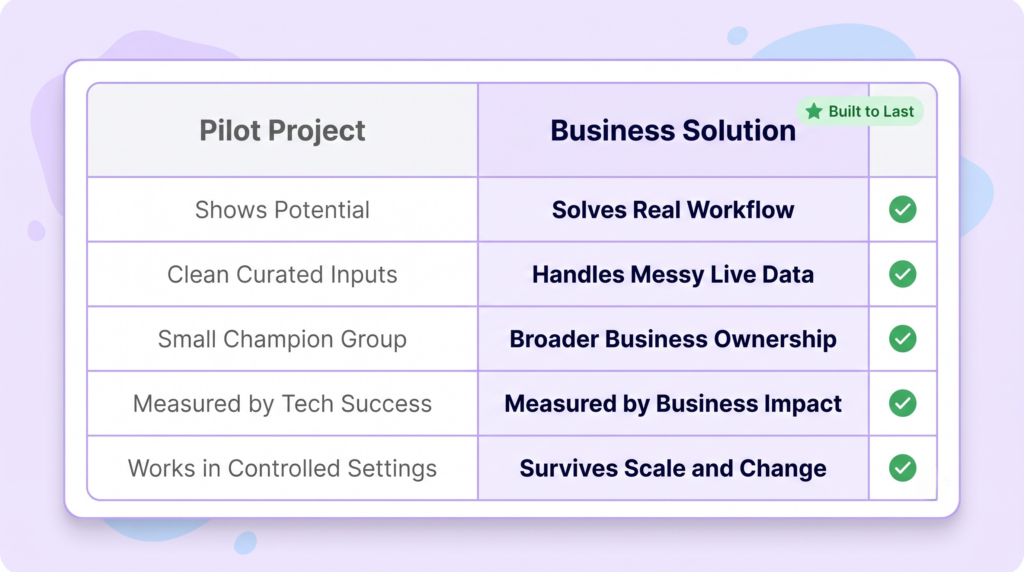
A pilot is supposed to prove a point. A business solution is supposed to hold up under pressure. That difference is why so many projects look successful in a sandbox and fail in production. Experimentation alone is not enough to achieve lasting AI success. Organizations need a clear path for moving from proof of concept to scalable, repeatable business operations.
| Pilot project | Business solution |
| Optimized to show potential | Optimized to solve a real workflow |
| Uses clean, curated inputs | Must handle messy live data |
| Depends on a small champion group | Needs broader business ownership |
| Measured by technical success | Measured by business impact |
| Works in controlled settings | Must survive scale and change |
This is also where agentic ai software is getting more attention. Companies do not just need a model. They need architecture, governance, orchestration, and evaluation.
Integration Is Where the Friction Shows Up
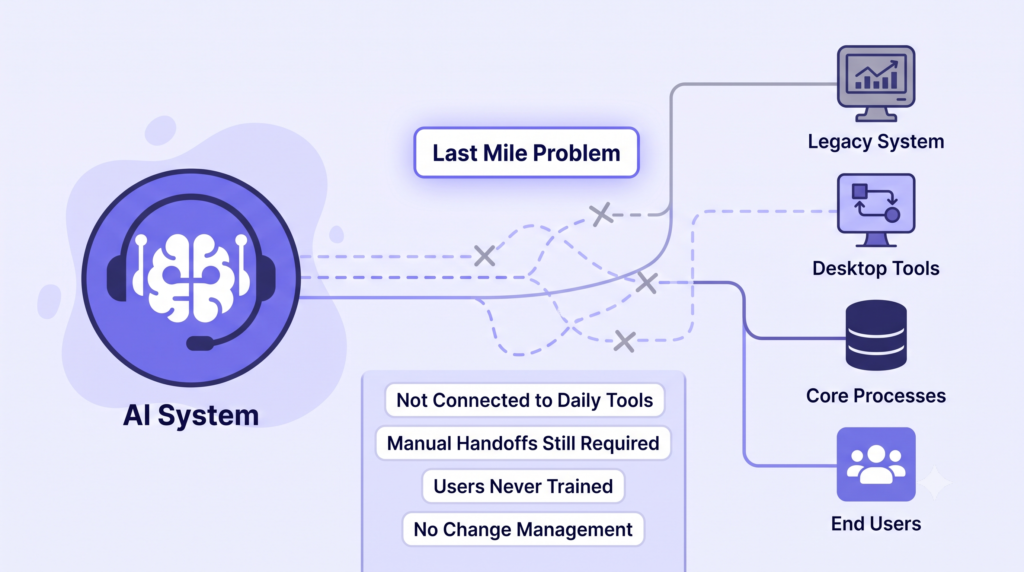
Even when the AI is helpful, integrating it can stop the project in its tracks. Legacy systems, desktop tools and disconnected workflows are still used to run core processes in many organizations. One of the most difficult challenges in enterprise AI is the “last-mile” problem, where AI agents are required to operate seamlessly across enterprise desktops, proprietary systems and existing business applications. This is often where many promising ideas fail to deliver actual business value.
That’s why so many enterprises are now looking for an artificial intelligence services company that can do more than just model building. They need help connecting AI to their existing systems, dealing with permissions, managing the adoption, and designing a workflow that people will actually use.
Integration usually fails because-
- The AI is not connected cleanly to daily tools
- The workflow still depends on manual handoffs
- Users were never trained on the new process
- The system was not designed with change management in mind
Ownership Is The Quiet Reason Good Ideas Stall
A surprising number of AI initiatives stall not because of technical weakness, but because nobody truly owns the outcome. The team building the model is not the team responsible for adoption. The business sponsor is enthusiastic at the start but disappears during rollout. Operations want reliability. IT wants control. Product wants speed. The project gets stuck between all three.
That is also why AI Ml services need to be framed as delivery support, not just engineering support. The most effective teams define one owner, one measurable problem, and one clear success metric before they build. If the goal is to reduce support time, shorten cycle time, or improve decision quality, that needs to be obvious from day one.
What Businesses Should Do Differently
Great AI ideas become business solutions only when they are treated like products, not experiments. That means aligning the use case, the data, the workflow, and the ownership model before development gets too far. It also means starting with a problem that matters enough for the business to maintain after launch.
The most durable artificial intelligence solutions usually share four traits-
- They solve one specific business problem
- They use data the organization can actually trust
- They fit into an existing workflow
- They have a measurable owner responsible for results
Final Thoughts
The market has clearly moved beyond AI curiosity. Companies are now building toward agents, orchestration, and production-grade automation. But the reason great ideas still fail is unchanged: the business side is harder than the demo side. If the data is weak, the workflow is vague, the ownership is unclear, or the rollout is treated like a side project, the idea will stall.
That is the real divide. The best artificial intelligence solutions are not the flashiest ones. They are the ones that survive contact with real work.