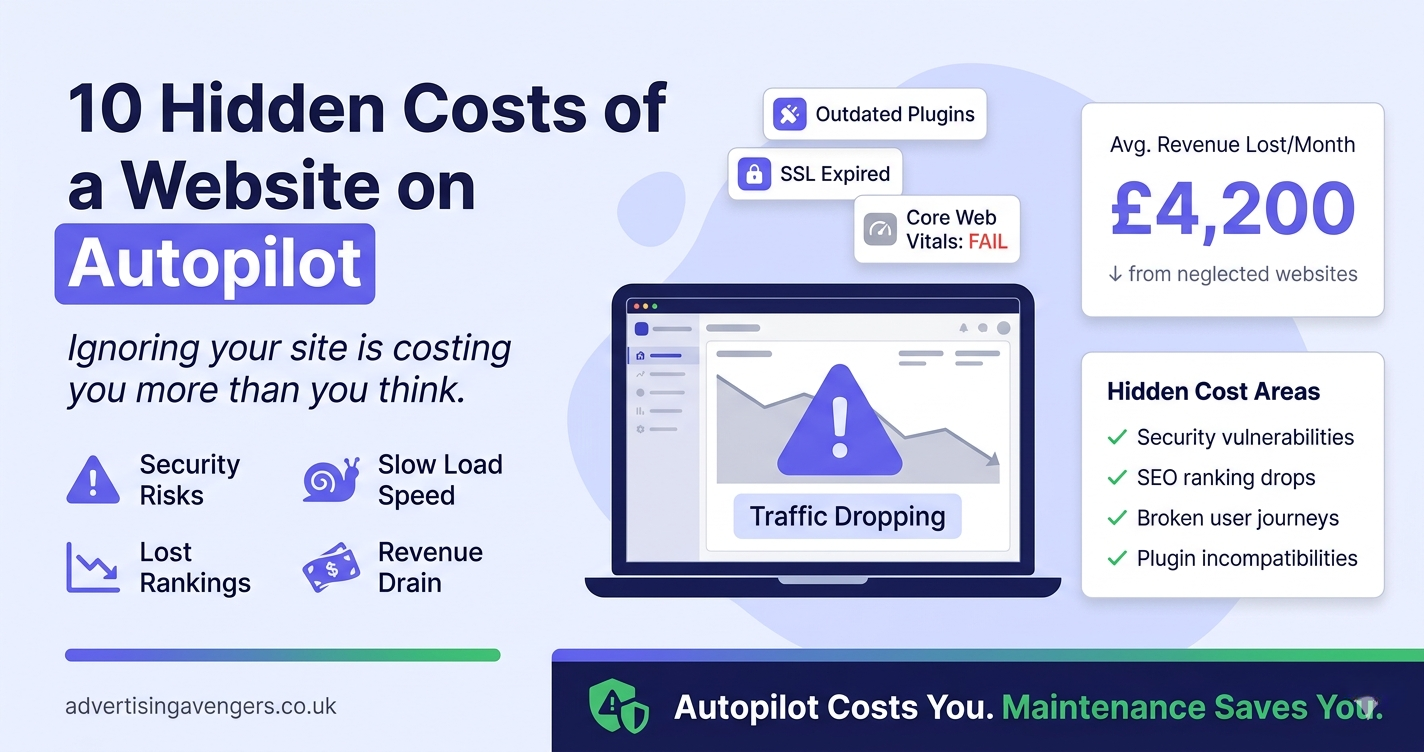
Most businesses treat a website launch as the finish line. It isn’t. The real cost of a neglected website doesn’t show up in a single moment — it accumulates quietly, in lost opportunities and eroding performance, until it’s too big to ignore. Here’s what it’s actually costing you.
1. Prospects who visit and leave without contacting you — and you rarely know why
Every week, potential clients land on your site, form an opinion, and move on. Conversion rate tracking can tell you how many left without acting — but it won’t tell you why. A site that looks untouched signals a company that isn’t growing, and that judgment happens in seconds. The number shows up in your analytics; the reason usually doesn’t.
2. Messaging that no longer matches how you actually sell
Your pitch has evolved. Your understanding of your customer has sharpened. The way your best salesperson describes what you do today sounds nothing like the homepage copy written two years ago. That gap matters — because the website is often the first place a prospect goes after a referral or a cold outreach, and if what they read doesn’t match the conversation that brought them there, you’ve already lost momentum.
3. A pricing or services page that reflects an old business model
Businesses evolve faster than most websites get updated. Services get retired, repositioned, or replaced. Pricing changes. New offerings don’t make it onto the site for months. The result is that prospects arrive informed by outdated information which either creates wrong expectations before the first call, or quietly disqualifies you before you ever hear from them.
4. Competitors who look more credible simply because their site looks more current
You don’t have to be worse than your competitors to lose to them on first impression — you just have to look less current. A prospect evaluating two similar options will read a recently refreshed site as a sign of a company that’s active, growing, and paying attention. An untouched site reads as the opposite. Credibility is relative, and it’s being assessed every time someone compares you to an alternative.
5. Sales cycles that take longer because the site doesn’t do enough pre-selling
A strong website does a significant portion of the sales job before your team gets involved. It answers objections, builds trust, and arrives prospects with context and confidence. When the site is outdated — missing recent case studies, thin on proof, light on specifics — that work falls entirely on your sales calls. Cycles get longer, more effort goes into convincing rather than closing, and your team spends time on education that the website should have already handled.
6. Organic search rankings that slide while you’re not watching
Search engines reward sites that demonstrate ongoing relevance — fresh content, good performance, clean structure. A site that hasn’t been touched in a year is quietly losing ground to competitors who are actively investing in theirs. The rankings don’t drop overnight; they drift. By the time the decline in organic traffic is obvious, it’s typically been compounding for months, and recovery takes considerably longer than prevention would have.
7. A marketing team routing around the site instead of using it
When the website is difficult to update, marketing finds workarounds. Announcements go on LinkedIn instead of the site. Campaign pages don’t get built because the process is too slow. Outdated offers stay live because nobody got around to removing them. Over time, the site stops being a marketing tool and becomes a liability the team has learned to work around — and all that lost execution velocity has a real cost on growth.
8. Case studies and social proof that are 2 years out of date
Your best recent clients aren’t on your website. The results you’re most proud of aren’t either. Prospects making a high-consideration purchase want current proof that you’ve done this for someone like them, recently. An outdated case study section doesn’t just fail to impress — it
actively raises doubt about whether the work shown still represents what you’re capable of today.
9. Slow page speed eating your conversion rate quietly
Page speed degrades over time. Scripts accumulate, images go unoptimized, plugins add weight. A site that loaded quickly at launch may be measurably slower a year later — and every additional second of load time costs conversion rate. This is one of the most quantifiable hidden costs of website neglect, and one of the least visible because no one is watching the numbers.
10. A rebuild bill that could have been avoided with consistent maintenance
This is where all the other costs converge. A site maintained consistently — updated, monitored, improved incrementally — stays relevant and performant for years. A site left on autopilot reaches a point where the gap between where it is and where it needs to be is too wide for incremental fixes. The result is a full rebuild: a project that costs multiples of what ongoing maintenance would have, for a problem that didn’t have to happen.
The pattern behind all of these is the same.A website isn’t a project with an end date — it’s a business system that requires ongoing attention to keep performing. The businesses that treat it that way don’t spend more. They just stop paying the hidden costs that everyone else absorbs without realizing it.